Temporal Platform
Abstract
Temporal is a workflow orchestration service that ensures the reliable execution of complex, multi-step processes. It automatically handles retries, state persistence, and recovery from failures, freeing developers from implementing these mechanisms manually. With cross-platform SDK support, Temporal allows workflow workers to be written in multiple programming languages while providing guaranteed, fault-tolerant execution across distributed systems.
Overview
Temporal is an open-source workflow orchestration platform designed to manage stateful, long-running business processes in a reliable and scalable way. It abstracts away complexities like retries, state persistence, timeouts, and distributed coordination, allowing developers to focus on business logic rather than infrastructure.
At its core, Temporal provides two main abstractions: Workflows and Activities.
Workflows define the high-level orchestration logic and are durable, meaning they can survive process restarts, crashes, or network failures.
Activities are the individual units of work—often short-lived tasks or service calls—that a workflow invokes. Temporal ensures activities are executed reliably and retries them automatically on failure.
Temporal uses event sourcing under the hood to maintain workflow state. Every decision, event, or activity is recorded in a durable event history, allowing workflows to resume exactly where they left off after failures or restarts. This makes it ideal for long-running processes, such as payment processing, data pipelines, or order management, where reliability is critical.
The platform supports multiple programming languages (Go, Java, TypeScript, and more) and integrates well with microservices architectures. Temporal handles timeouts, retries, and backoffs, and provides visibility tools for monitoring workflow execution, debugging, and tracing. It is widely used by organizations needing resilient, fault-tolerant, and highly maintainable orchestration without building complex orchestration frameworks from scratch.
Expand to show a more extensive diagram
- Sequential and Parallel Execution: Shows both linear and parallel activity flows.
- Conditional Branching: Supports different workflow paths based on runtime conditions.
- Retries, Timeouts, Backoffs: Temporal automatically retries failed activities.
- Event History: Every activity and workflow decision is logged to ensure deterministic replay.
- Crash Recovery: Workflow resumes exactly where it left off by replaying the event history.
Here are the key points about Temporal and its use in the Xavier framework:
What is Temporal?
Temporal is used to ensure that complex, multi-step processes execute reliably and predictably. Essentially, it acts as a service or engine that manages workflows made up of individual commands or steps. Its standout feature is reliability: if a process step — called an Activity — fails, or if the server restarts unexpectedly, Temporal automatically retries the step or resumes the workflow from where it left off, using the results of the previously completed steps.
From a developer’s perspective, Temporal removes the need to manually implement retry logic, persist state, or track the execution of long-running operations. This not only reduces development complexity but also greatly improves system reliability.
Another key advantage is its cross-platform support. Temporal provides SDKs and clients for multiple programming languages, including JavaScript, TypeScript, .NET, and Java. This flexibility allows developers to write workflow workers in whichever language is most convenient, all while seamlessly connecting to the Temporal service.
Core Concepts
- Workflow: A process consisting of a sequence of steps. In XAVI, it is recommended to use Temporal for any process that resembles such a multi-step workflow.
- Activity: An individual, atomic step or command within a Workflow. Each data output (e.g., database write, message sending) is formalized as a separate Activity.
- Worker: A separate process that is capable of handling a specific Workflow type. For a Workflow to execute, a corresponding worker must be running and "listening" to a specific queue.
- Namespace: Groups of Workflows, often segmented by service (e.g., Model Registry).
Usage in the Xavier Framework
In the Xavier Framework, Temporal serves for workflow executions across the system. It is actively used in the Model Registry for tasks such as model validation and webhook processing, and in the AI Studio for video and image generation. Temporal is an integral part of the system, and without it, many functions would not operate correctly.
To keep things organized, all workflow and activity interfaces are defined in a dedicated project:
This centralized setup makes it easier to understand the available workflows, their parameters, and how to invoke them.
Temporal Web UI is available at the following address:
It is a visual interface to monitor, manage, and inspect workflows:
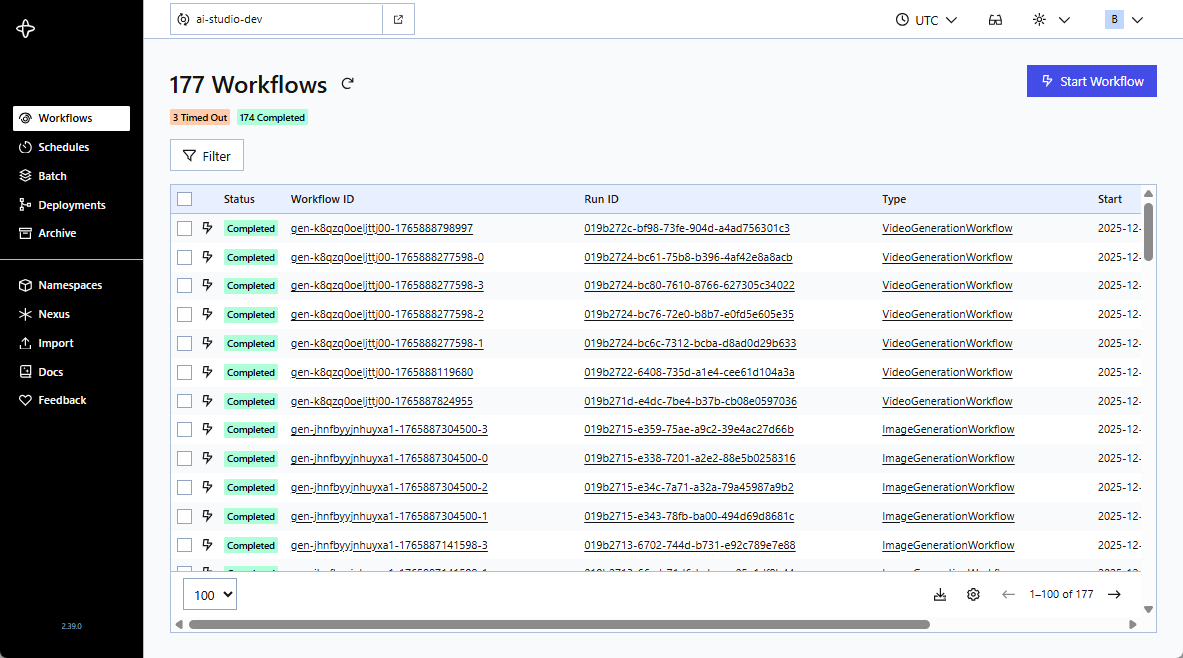
At present, some workers, such as those responsible for image generation, are running outside the main backend in separate JavaScript and TypeScript projects. These are temporary measures, and the development plan is to eventually bring them into the main backend.
Impact on Performance
- Temporal might run slower than if the same steps were implemented with simple sequential code, due to overhead for data transfer and saving intermediate results.
- However, for long-running operations (e.g., model startup, which can take up to two hours, or image generation—about two minutes), this overhead is negligible compared to the total execution time, and the reliability benefits outweigh the small speed trade-off.